
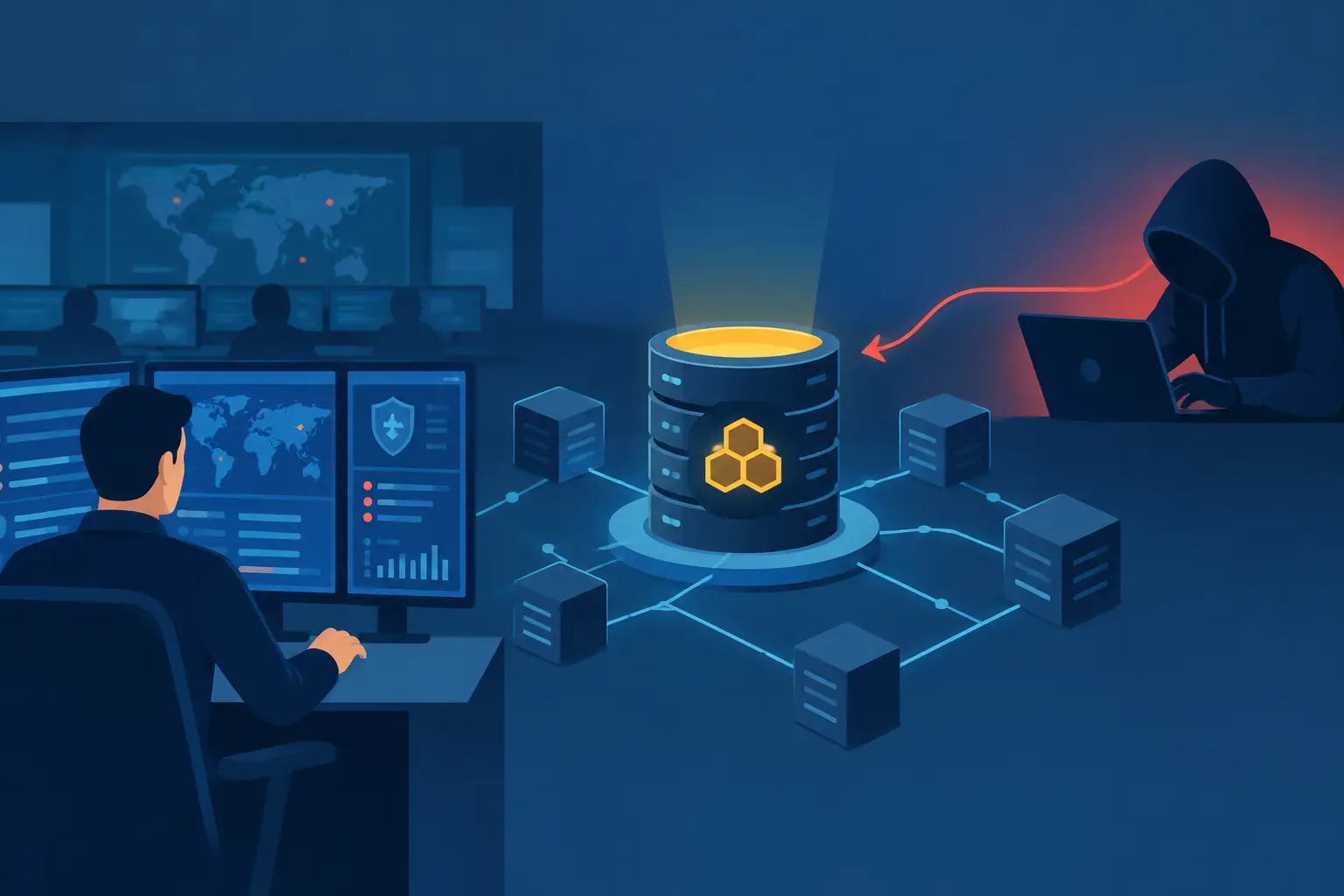
A threat actor has already obtained a valid credential. Your EDR may see a successful sign-in, but it cannot tell you whether the user intended to access a file share, query Active Directory or begin lateral movement. That is where the decision to how to deploy deception technology becomes operational, not theoretical: the attacker touches an asset that no legitimate user should ever need, and your SOC receives a high-confidence signal.
Deception technology gives defenders a way to shape the attacker’s path. Rather than waiting for a known malicious file or a suspicious behaviour chain to cross a detection threshold, it places believable traps inside the estate: decoy hosts, credentials, services, files, shares and identity artefacts. An interaction is meaningful precisely because it should not happen in normal business activity.
The value is not in filling the network with fake machines. It is in deploying the right deceptive assets, in the right places, with a response process that turns an alert into fast containment. Get that balance right and deception becomes a force multiplier for EDR, XDR, NDR and human-led investigation.
Start with an attacker path, not a product console
The fastest way to waste a deception investment is to begin by deploying every available decoy. Security teams then inherit alerts they do not understand, infrastructure owners become wary, and the programme loses momentum. Begin with the behaviours you want to expose.
For many organisations, the priority is credential misuse and lateral movement following an initial foothold. Map the routes an intruder is likely to take: a compromised endpoint searching for administrator credentials, an attacker enumerating Active Directory, a service account being used against a server, or a cloud identity moving towards privileged resources.
Set a small number of clear detection objectives. For example, detect unauthorised access to privileged credentials, reveal reconnaissance against high-value server segments, and identify lateral movement across a specific business-critical environment. Each objective should have an owner, a response expectation and a way to measure success.
This approach also makes the commercial case sharper. A cyber security buyer is not purchasing decoys; they are reducing the time between attacker movement and defender action. Vendors taking a deception proposition into the UK market should lead with that operational outcome, not a feature inventory.
How to deploy deception technology without creating noise
A productive deployment begins with a short discovery phase. Security, infrastructure, identity and network teams need a shared view of where privileged access lives, how administrators work, which segments are sensitive, and what change controls apply. This is not bureaucracy. It is how you make decoys credible without disrupting real services.
Place decoys where attackers will look
High-value zones are usually better than broad, random coverage. Start with segments that contain crown-jewel applications, domain services, administrative jump hosts, file servers and management platforms. A decoy asset placed near a route an attacker is likely to traverse has far more value than one isolated in an unused subnet.
Make each asset match its surroundings. Naming conventions, operating system profiles, open ports, shares and apparent business purpose should be plausible for that network. A fake finance server should resemble the organisation’s real server estate. A deceptive service should not expose a configuration no internal system would use.
Credential lures can be especially effective because they travel with the attacker’s likely workflow. These may appear in carefully controlled locations such as a decoy share, a configuration file or a deceptive administrative record. The aim is never to leave uncontrolled secrets behind. The aim is to create monitored credentials or tokens that immediately identify unauthorised use.
Cover identity as seriously as endpoints
Identity is often the route through which an intrusion becomes a material incident. Attackers enumerate users, groups, trusts, service accounts and privileged roles because that information reveals where to move next. Deceptive identity objects and monitored credentials can expose this activity early, often before the attacker reaches a production workload.
The exact design depends on your directory architecture and privileged-access model. A mature environment with tightly managed tiered administration may use highly targeted lures. A distributed estate with legacy systems may need broader coverage around service accounts and remote management protocols. There is no universal template – credibility and safety matter more than deployment volume.
Keep decoys out of business workflows
A strong deception alert should be rare. That means avoiding assets that legitimate users, vulnerability scanners, backup jobs or asset-discovery tools will routinely touch. Where approved scanners must interact with a decoy, document and tune that activity rather than suppressing alerts blindly.
Before go-live, test expected operational behaviour. Check monitoring tools, patching systems, endpoint agents, network scans and administrators’ standard procedures. If a genuine process repeatedly triggers an alert, either move the lure or adjust its design. Do not train analysts to ignore it.
Build the SOC workflow before activating alerts
Deception is powerful because an alert can be high confidence. High confidence does not mean automatic certainty. A SOC still needs context: who used the account, which device initiated the connection, what processes ran beforehand, where else the identity has been active and whether the event aligns with approved maintenance.
Route deception telemetry into the same investigation workflow as your EDR, XDR, SIEM and NDR data. The alert should enrich, rather than sit beside, the evidence analysts already use. If a decoy credential is accessed, the analyst should be able to pivot quickly to endpoint process activity, authentication logs, DNS requests, network flows and email events.
Define severity in advance. A connection to a low-risk decoy may create an urgent triage case. Use of a deceptive privileged credential or interaction with a decoy domain controller should trigger a pre-agreed containment path. That could include isolating the endpoint, disabling or rotating the affected account, preserving evidence and checking for related activity across the environment.
For larger teams, write a concise playbook covering the first fifteen minutes. It should state what to validate, who can authorise containment, when to involve identity or infrastructure teams, and what evidence must be retained. The point is speed with control. A well-designed trap is only useful if the response is equally disciplined.
Test from the attacker’s perspective
Deployment is not complete when agents are installed and dashboards show green. Run controlled tests that resemble the techniques you expect an adversary to use. Attempt to discover the decoy, access its share, authenticate with a monitored credential or scan the relevant segment. Confirm that the alert reaches the SOC, the enrichment is available and the team can follow the containment process.
This is also where adversarial exposure validation adds value. Identifying an exposed service or a theoretical weakness is useful, but security leaders need to know whether it can actually lead to exploitation and onward access. Testing attacker paths validates whether your controls, including deception, expose meaningful behaviour at the right moment.
Measure outcomes that matter to the business. Track time to triage, time to contain, confirmed unauthorised interactions, false-positive rate and coverage of priority attack paths. Avoid treating the number of decoys as a success metric. Ten well-positioned assets that produce actionable detections are more valuable than hundreds of decoys nobody trusts.
Scale coverage in deliberate phases
A phased rollout protects confidence. Start with one high-value use case, such as privileged credential misuse in a server segment. Run it long enough to tune operational noise, prove the response workflow and show analysts what a quality deception signal looks like. Then extend into identity, cloud workloads, remote sites or additional business units.
Cloud and hybrid environments need particular care. Deceptive resources must align with cloud governance, tagging, logging and cost controls. They also need to resemble genuine workloads closely enough to attract attacker interest without being mistaken for a real production service by internal teams. The deployment model may differ, but the principle remains the same: place believable signals along plausible routes to valuable assets.
Fidelis Security can support this broader detection strategy by combining deception with endpoint, network and extended detection capabilities. The strongest deployments do not position any control as a standalone answer. They use each signal source to shorten investigation time and make containment decisions more confident.
A deception programme earns its place when it changes an attacker’s economics. Make reconnaissance riskier, credential abuse visible and lateral movement harder to hide. Start narrow, validate every alert path and expand only when your SOC can act at speed. That is how a decoy becomes a genuine advantage rather than another console to manage.