
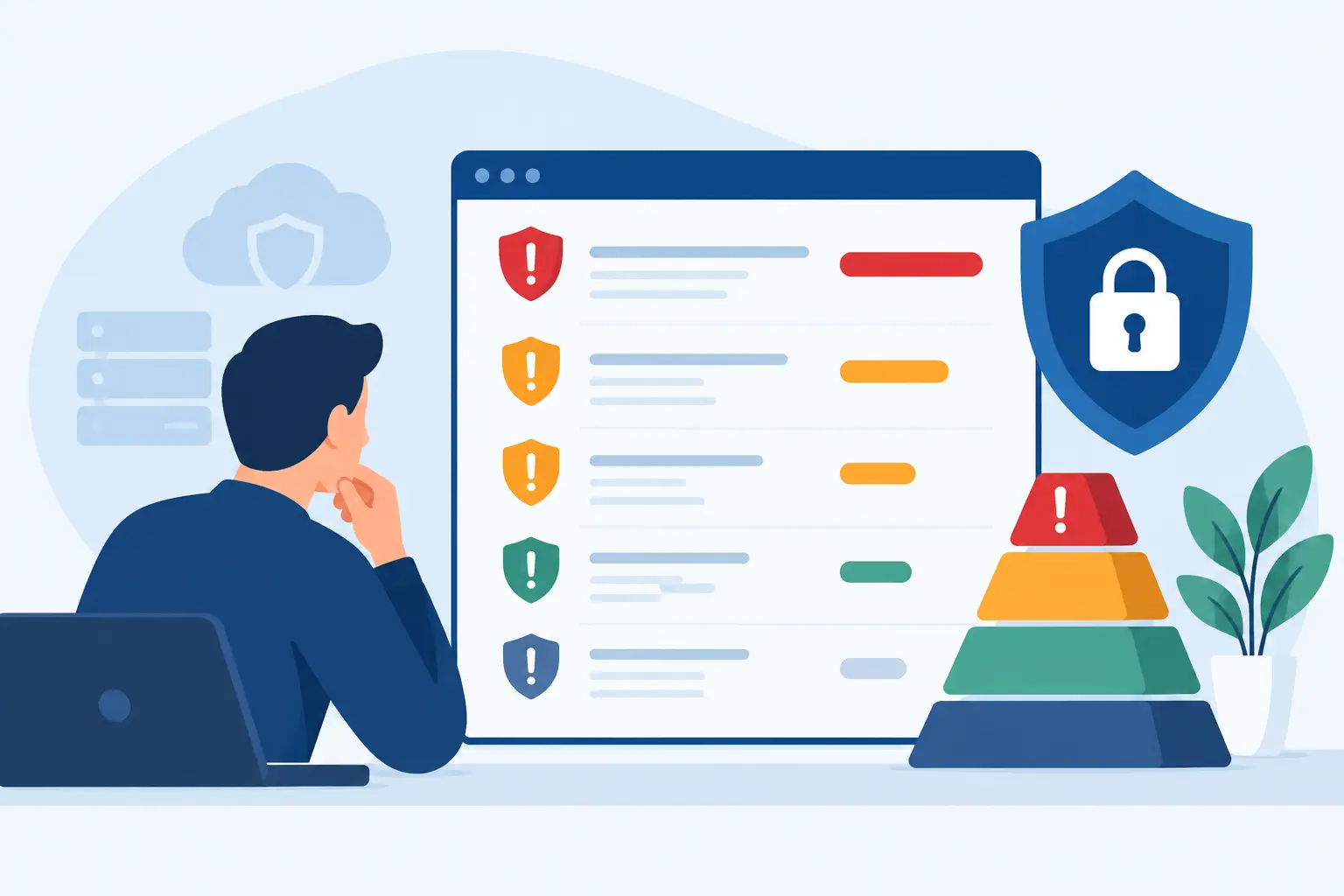
A critical CVSS score can demand attention, but it does not automatically represent your greatest exposure. If the affected asset is isolated, patched through routine change control or protected by compensating controls, it may be far less urgent than a medium-severity weakness on an internet-facing system. Knowing how to prioritise exploitable vulnerabilities means separating theoretical risk from the routes an attacker can genuinely use to reach valuable systems, data and identities.
For security leaders, this is more than an operational tidy-up. It determines whether analysts spend their week closing real attack paths or chasing a growing backlog of alerts that will never become incidents. The goal is not to patch everything at once. It is to apply laser focus where exploitation is credible, impact is meaningful and time matters.
Why severity scores alone create the wrong queue
CVSS remains useful. It provides a common language for describing the technical characteristics of a flaw and helps teams make an initial assessment. The problem begins when it becomes the sole decision-maker.
A score cannot reliably account for your environment. It does not know whether a vulnerable application is exposed to the public internet, whether it is reachable only through a segmented network, whether an exploit is available, or whether the asset processes customer data and supports revenue-critical operations. Nor does it understand whether an attacker needs a valid account, a particular configuration or several earlier compromises to make use of the weakness.
This is why teams can patch hundreds of high-scoring vulnerabilities while leaving a smaller number of highly accessible, exploitable issues open. Attackers do not organise their campaigns around your vulnerability scanner’s severity filters. They look for the shortest practical route to access, privilege and impact.
The commercial consequence can be severe. A security programme that cannot show why the most dangerous exposures were addressed first will struggle to give the board confidence, especially after an incident. Better prioritisation creates a defensible, evidence-led remediation plan and helps security teams explain where investment, ownership and urgent action are required.
How to prioritise exploitable vulnerabilities in practice
Start by asking a more useful question than which vulnerability has the highest score: can an attacker exploit this weakness in our environment, and what can they achieve if they do?
That question needs evidence from several sources. External attack surface information reveals whether an asset is visible and reachable. Asset intelligence establishes its owner, function, data sensitivity and business criticality. Threat intelligence indicates whether exploitation is active or likely. Security telemetry helps identify whether the weakness is already being probed, abused or chained with another control failure.
The result should be a prioritisation decision based on three connected factors: exploitability, exposure and consequence.
Establish whether exploitation is realistic
First, confirm the technical conditions. Is the vulnerable service live? Is the affected version actually in use? Is a working exploit publicly available, included in attacker tooling or being used in active campaigns? Does exploitation require low-skilled interaction, authenticated access or a complex sequence of conditions?
Public proof-of-concept code increases urgency, but it is not the whole story. A remotely exploitable flaw in a common edge device may warrant rapid action even before widespread exploitation is reported. Conversely, a vulnerability with dramatic technical wording may be a lower priority if it requires local access to a tightly managed workstation and delivers limited privilege.
This is where adversarial exposure validation changes the quality of the decision. Rather than assuming a finding is exploitable because a scanner detected it, an attacker-led validation approach tests the practical path. Armory Defence’s AEV platform is designed around this principle: continuously assessing external exposure from an attacker’s perspective to identify what could actually be exploited.
Validation must be carefully controlled. The purpose is not to run uncontrolled tests against production systems. It is to produce credible evidence that helps defenders distinguish a theoretical finding from an attack route that deserves immediate ownership.
Measure exposure, not just asset inventory status
An asset marked as managed is not necessarily protected. Security teams need to know whether it is externally exposed, how it can be reached and whether the path is protected by a WAF, VPN, identity control or network segmentation.
Internet-facing systems deserve particular scrutiny because they are available to attackers without an initial foothold. That includes remote access services, web applications, cloud management interfaces, exposed development environments and third-party platforms connected to core operations. A vulnerability that enables unauthenticated remote code execution on an exposed system should move rapidly to the front of the queue, even if another finding has a marginally higher score.
Exposure also changes over time. A system that was internal yesterday may become externally reachable after a cloud configuration change, a temporary support requirement or a forgotten test deployment. Continuous discovery matters because a static quarterly scan can miss the moment when a manageable weakness becomes an active opening.
Put business impact into the decision
Technical teams cannot prioritise effectively without reliable business context. An exploitable flaw on a system holding regulated data, supporting customer transactions or managing privileged identities has a different potential impact from the same flaw on a low-value test server.
This is not an argument for labelling every asset critical. Over-classification creates another noisy queue. Instead, establish practical tiers based on what a compromise would enable: loss of sensitive data, disruption of revenue, lateral movement into key systems, fraud, operational outage or material regulatory exposure.
Identity is often the multiplier. A modest vulnerability that gives an attacker access to an administrator session, authentication token or identity provider can be more dangerous than a severe flaw on a standalone device. Prioritisation should account for privilege gained and the next systems an attacker could access, not merely the first asset affected.
Build a queue your teams can act on
A useful remediation queue is short, owned and time-bound. If every finding is tagged urgent, nothing is urgent. Define clear service levels that reflect demonstrated risk rather than severity alone.
For example, an externally reachable vulnerability with confirmed exploitability and a credible path to sensitive data should trigger immediate containment and a tightly managed remediation window. A weakness with no practical route to exploitation can enter planned patching, with the decision and evidence recorded. The middle category – exposed but unproven, or exploitable with limited impact – needs compensating controls, closer monitoring and a clear review date.
Each priority item should name the asset owner, the remediation owner, the agreed deadline and the interim control. An interim control may include removing public exposure, restricting access, disabling a vulnerable feature, applying a virtual patch, increasing monitoring or isolating the affected service. These measures do not replace patching, but they can reduce exposure while change control is completed.
Avoid treating remediation as a security-only task. Infrastructure, cloud, application and business service owners each hold part of the answer. Security’s role is to provide the evidence, make the risk clear and keep momentum when competing operational demands threaten to delay action.
Use detection to test your assumptions
Prioritisation should feed detection and response, not sit separately from them. If an issue cannot be patched immediately, use EDR, XDR and network visibility to look for the behaviours associated with exploitation: suspicious child processes, unusual authentication activity, privilege escalation, lateral movement or command-and-control traffic.
This is especially valuable when a vulnerability sits on a critical system where downtime is difficult to secure. Detection does not make an exploitable weakness acceptable, but it can narrow the window of opportunity and provide evidence if an attacker begins to act.
Threat intelligence should also adjust priorities dynamically. A previously lower-risk vulnerability can become urgent when it appears in ransomware campaigns, is added to a widely used exploitation framework or is targeted within your sector. The queue must be able to change quickly without creating panic or abandoning accountable decision-making.
Measure whether prioritisation is improving risk
Patch compliance percentages are easy to report but can hide the real picture. A better measure asks how long known, exploitable exposures remain open on critical and internet-facing assets. Track the number of validated attack paths removed, the time from discovery to containment, and the proportion of priority findings with a named owner and documented mitigation.
These metrics create a stronger conversation with senior stakeholders. They demonstrate that security is reducing routes to compromise, not simply processing tickets. They also reveal recurring weaknesses, such as unmanaged external assets, slow ownership decisions or applications that cannot be patched without disproportionate operational disruption.
The most effective vulnerability programme is not the one with the smallest scanner backlog. It is the one that repeatedly removes the attack paths adversaries can use before those paths become incidents. Give your teams the evidence to act, the authority to escalate and a queue built around what is genuinely exploitable.